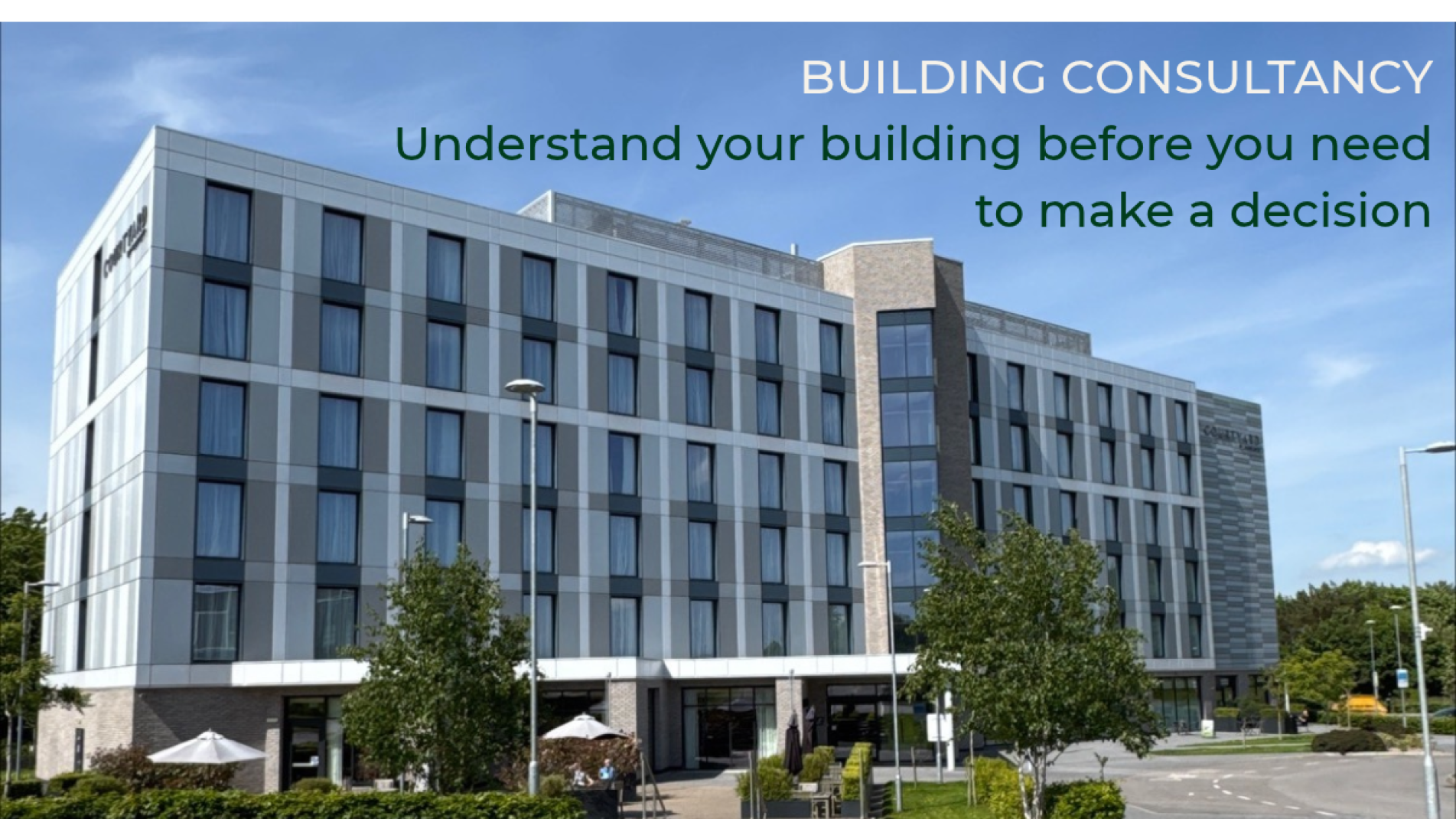
Understand Your Building Before You Need to Make a Decision
Poole Dick | Building Consultancy
Buildings are long-term assets, but decisions about them are often triggered by short-term events. A maintenance issue becomes urgent, a refurbishment is proposed, a property is being acquired, or changing legislation introduces new requirements. Whether purchasing a property or managing an existing building, understanding its condition and anticipating future needs is essential to protecting its value.
Without a clear understanding of an asset’s condition, maintenance requirements and potential risks, building owners can find themselves reacting to problems rather than planning ahead. Delaying essential works, overlooking the need to replace ageing components or failing to anticipate changes in legislation can lead to unplanned expenditure, disruption and works being carried out in the wrong sequence.
The challenge is that waiting until a decision becomes unavoidable can significantly limit the options available. Issues that could have been addressed through planned investment become urgent priorities, often competing with other financial and operational demands.
Poole Dick’s Building Consultancy service helps clients take a more proactive approach. Rather than simply responding when something goes wrong, the service provides building owners, occupiers and investors with the technical insight needed to understand their assets, anticipate future requirements and make better-informed decisions about what happens next.
The Cost of Reactive Decision Making
Buildings change over time. Materials deteriorate, components reach the end of their expected life, legislation evolves, and the way buildings are used changes. None of this necessarily represents a problem if it is understood and planned for. The difficulty comes when those changes are identified too late.
Reactive maintenance can be disruptive and expensive, particularly where a failure affects the operation of a building or requires urgent intervention. It can also make investment decisions more difficult. When several competing priorities emerge simultaneously, organisations may be forced to address the most immediate problem rather than the issue that represents the greatest long-term risk.
A more informed approach starts by understanding condition before intervention becomes urgent. This allows building owners and estates teams to identify priorities, consider options and develop a programme of investment that reflects both the needs of the asset and the resources available.
Understanding the Asset Before Making the Decision
A condition survey can provide an important snapshot of a building, but the information itself is only the starting point. The real value lies in understanding what those findings mean for the organisation responsible for the asset.
That means looking beyond individual defects to consider condition, compliance, performance, risk and future requirements together. What requires immediate attention? What can be monitored? Where is investment likely to be required over the next few years? Could planned works be coordinated to minimise disruption or improve value?
This wider perspective turns technical information into something much more useful: a basis for decision-making.
“A condition survey should be the start of the conversation, not the end of it. The real value comes from understanding what the findings mean, where the priorities sit and how that information can support better decisions about the building.”
Lee Podmore, Associate, Poole Dick
Refurbish, Adapt or Replace?
The drive towards more sustainable development is also changing the way existing buildings are considered. Demolition and replacement are not automatically the only, or necessarily the most appropriate, solutions when an asset no longer meets its original requirements.
Existing buildings may have the potential to be refurbished, adapted or repurposed, but those decisions need to be based on a realistic understanding of condition and performance. The existing structure, fabric, services, compliance requirements and likely future maintenance all need to be considered and costed alongside the objectives for the building.
This is particularly important when organisations are balancing environmental ambitions with financial constraints. Retaining and adapting an existing asset may offer significant benefits, but only where the technical evidence supports the decision. Poole Dick’s Building Consultancy service provides that evidence, helping clients understand both the opportunities and the limitations before committing to a particular route.
Turning Condition Data into an Investment Strategy
For organisations managing multiple properties, understanding individual buildings is only part of the challenge. Estates teams also need to determine where limited resources should be directed across an entire portfolio.
Condition information can help create that hierarchy. Rather than treating every maintenance requirement equally, organisations can consider urgency, risk, operational impact, lifecycle and available budget together. Planned maintenance programmes can then be developed around genuine priorities, allowing investment to be phased and future expenditure anticipated more effectively.
This changes the conversation from “What needs repairing?” to “Where should we invest, when should we invest, and what will that investment achieve?” It is a subtle distinction, but an important one. Planned maintenance becomes part of asset strategy rather than simply a response to deterioration.
Due Diligence Before Commitment
The same principle applies when acquiring a property or considering an investment. A building may appear suitable operationally or commercially, but its physical condition can carry liabilities that are not immediately apparent.
Pre-acquisition surveys and technical due diligence can help identify defects, maintenance liabilities, compliance considerations, and potential future expenditure before a commitment is made. This does not necessarily mean identifying reasons not to proceed. Instead, it allows the decision to be made with a clearer understanding of the asset and the investment that may be required.
That information can influence negotiations, budgets, refurbishment plans and long-term investment strategies. Understanding the building before acquiring it provides considerably more scope to manage risk than discovering those issues afterwards.
“Good due diligence isn’t simply about finding defects. It’s about giving clients a clear picture of the asset so they understand the risks, liabilities and opportunities before making a commitment.”
Paul Newman, Director, Poole Dick
Different Buildings Require Different Priorities
There is no universal approach to managing an existing building. A school, residential development, commercial property or public estate will each have different operational requirements, occupiers, budgets and priorities.
For a public sector estates team, continuity of service and the ability to plan capital expenditure may be particularly important. For a developer or investor, the focus may be on understanding liabilities and the potential for refurbishment or redevelopment. For an architect developing proposals for an existing building, reliable information about its condition and constraints can provide a much stronger foundation for design. Contractors also benefit when existing conditions are understood earlier, reducing the potential for unexpected discoveries once work begins.
From Technical Information to Better Decisions
Buildings generate a considerable amount of technical information throughout their lives, but information alone does not improve an asset. Its value depends on how effectively it is interpreted and translated into action.
At Poole Dick, our building surveying expertise helps clients make that connection. Surveys, assessments and technical advice provide the evidence, but the objective is to help clients understand what matters, establish priorities and determine an appropriate way forward.
That might mean developing a long-term planned maintenance programme, informing an acquisition, supporting a refurbishment strategy or identifying where further investigation is required. In each case, the purpose is the same: to replace uncertainty with a clearer understanding of the asset and the decisions surrounding it.
Planning Ahead Creates More Choice
The greatest advantage of understanding a building early is that it creates options. When condition, risk and future requirements are understood before they become urgent, clients have more time to plan, budget and consider alternative approaches.
That can mean coordinating works rather than carrying them out independently, addressing an issue as part of a wider refurbishment, phasing expenditure over several years or deciding that investment would be better directed elsewhere. It also gives project teams the information they need earlier, reducing the likelihood of unexpected issues influencing cost or programme later.
In a built environment where budgets are under pressure and expectations around performance, compliance and sustainability continue to increase, that ability to plan ahead is increasingly valuable.
The most useful building insight is therefore not simply the information that tells us what has already gone wrong. It is the information that helps clients understand what is likely to happen next, what their options are, and what they should do about it.
For more information or to discuss our Building Consultancy, contact Lee Podmore or Paul Newman on +44 (0)1782 443 030 or email: l.podmore@pooledick.co.uk or p.newman@pooledick.co.uk

The Footprint We Leave Behind
Pop into our Stoke office on a Monday morning and there’s a good chance you’ll stumble upon a training session taking place in our board…
Learn More

Happy 60th Birthday Martin – Never too old for balloons and cake
A very happy 60th Birthday to Martin Brownsill Managing Director – never too old for balloons and cake. Martin has spent 39 years (since 1986)…
Learn More

From Policy to Practicality: Rethinking Planning to Deliver Growth
Following on from the flagship insight early this month, the ‘Blueprint for Growth’, we now look to deliver several insights discussing each area in more…
Learn More