
Building the Pipeline: Why Skills, Perception and Visibility Matter
If growth is the ambition and delivery is the challenge, then people are the enabler.
Throughout Poole Dick’s Question Time discussion, there was widespread recognition that the construction industry faces a significant workforce challenge. Yet the conversation quickly moved beyond the traditional narrative of skills shortages and labour gaps.
The issue, as several panel members highlighted, is more complex than simply finding more people.
It is about creating a sustainable pipeline of talent and ensuring the industry remains visible, attractive and accessible to future generations.
One of the most positive aspects of the discussion was the acknowledgement that progress is being made.
Greater Manchester’s approach to skills development was highlighted as a particularly encouraging example, with initiatives designed to support young professionals throughout the early stages of their careers. Rather than focusing solely on attracting people into the industry, there is increasing recognition of the importance of supporting and retaining talent as careers develop.
This is particularly important during the critical period between years three and eight, when individuals often make decisions about their long term future within a profession.
Without that support, the industry risks losing talented individuals just as they begin to gain valuable experience.
“The Greater Manchester plan for supporting young professionals is genuinely exciting.” – Michele Steel
The discussion also challenged some long-held assumptions about recruitment.
While skills shortages remain a concern, several panel members argued that awareness and perception may represent an even bigger challenge.
Many young people simply do not understand the breadth of opportunities available within the built environment.
Construction is often viewed through a narrow lens, despite offering careers across project management, planning, design, engineering, sustainability, digital technology, commercial management and countless other disciplines.
As a result, potential talent is often lost before it has even considered the industry as an option.
This creates a responsibility for employers as well as educators.
“Employers need to be more involved.” – Angela Mansell
The panel was clear that the industry cannot rely solely on schools, colleges, and universities to solve the challenge. Businesses themselves must play a more active role in engaging with future talent, showcasing career opportunities, and creating clearer pathways into the profession.
The conversation also touched on how that engagement needs to evolve.
Today’s young people consume information differently from previous generations. Traditional careers fairs and recruitment campaigns still have a role to play, but they are no longer enough on their own.
One of the more memorable moments of the discussion came when the panel reflected on the importance of meeting people where they already are.
“The industry needs to get on TikTok and Instagram.” – Panel discussion
While partly delivered with humour, the underlying message was serious.
Visibility matters.
If the industry wants to attract future talent, it must communicate through the channels that younger audiences actively use. That means embracing new platforms, new formats, and new ways of telling the story of the built environment.
Ultimately, the skills challenge is not simply about recruitment.
It is about perception, engagement, retention, and opportunity.
The North West has ambitious plans for growth over the coming decade. Delivering that growth will require more than funding, policy, and projects.
It will require people.
Building that pipeline starts today, and it will depend on the industry’s willingness to engage, adapt, and invest in the next generation.
Because the future of the built environment will not be defined by the projects we plan.
It will be defined by the people who deliver them.
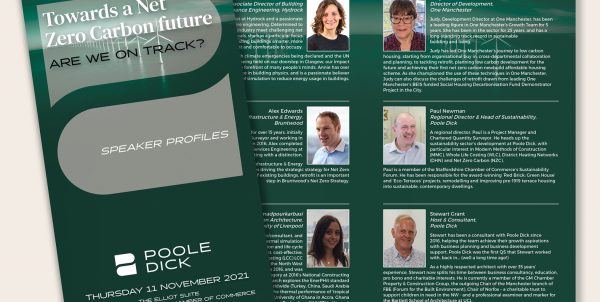
Fantastic to see so many people at our net zero carbon event in Manchester!
‘Towards a Net Zero Carbon future – are we on track?’, Thursday 11 November What a brilliant turnout for our net zero carbon event in…
Learn More

Poole Dick Selected for Innovation Chain North Framework
Poole Dick has been chosen to provide consultancy services for the new Innovation Chain North (ICN) framework, managed by social landlord Great Places Housing Group.…
Learn More

Empowering Clients: How Reinstatement Cost Assessments Enhance Confidence and Security in Construction Projects
Understanding how Reinstatement Cost Assessments (RCA) directly benefits clients is essential for delivering maximum value. This article explores the advantages of RCAs for portfolio holding…
Learn More