Rethinking Value for Money in Construction Projects
In today’s construction environment, delivering value for money has never been more important or more complex. Rising construction costs, economic uncertainty, changing funding landscapes, increasing regulatory requirements, and growing sustainability expectations all mean that clients are under pressure to make every pound work harder. Against this backdrop, it can be tempting to interpret value simply as achieving the lowest possible price.
In reality, the lowest cost does not necessarily represent the best value. True value for money comes from achieving the right balance between cost, quality and time, whilst ensuring that decisions remain aligned with the objectives of the project. Effective cost management therefore has a much broader role to play than simply controlling expenditure. It should help clients understand their options, assess the implications of different decisions and invest where that investment will deliver the greatest benefit.
The Problem with Lowest Cost Thinking
Focusing too heavily on initial cost can create consequences elsewhere in a project. A lower cost solution may compromise quality, increase future maintenance requirements, affect programme delivery or reduce the long-term performance of an asset. What appears to be a saving at one stage can therefore result in additional expenditure later.
This is where good cost management can add significant value. Rather than focusing on reducing cost at all costs, the objective should be to understand where money is being spent, why it is being spent, and what that investment is expected to achieve. Cost becomes part of the decision-making process rather than simply a figure to be controlled.
“Cost management isn’t about driving numbers down. It’s about helping clients make the right decisions with the right information at the right time.”
Andrew Bayley, Director, Poole Dick
Defining What Value Actually Means
Value for money will not mean the same thing on every project. For one client, speed of delivery may be the overriding priority. For another, durability, sustainability, operational efficiency or quality may carry greater weight. The important point is to establish those priorities at the beginning and ensure that they remain visible and considered as the project develops.
Without a clear understanding of what success looks like, it becomes much harder to make consistent decisions about design, specification, procurement and expenditure. Establishing a clear baseline early allows the project team to assess options against agreed objectives rather than making cost decisions in isolation. It also provides a much stronger basis for demonstrating whether value has ultimately been achieved.
Procurement Is Part of the Value Equation
The procurement strategy can have a significant influence on cost certainty, risk allocation, programme and collaboration. Selecting between a single-stage, two-stage, negotiated or Early Contractor Involvement approach should therefore be driven by the needs and risk profile of the individual project rather than simply following a familiar route.
The same principle applies to the choice of contract. Procurement and contractual strategy need to work together and reflect the complexity of the project, the client’s objectives and the way risk is best managed. When these decisions are made carefully and early, they can create the conditions for better collaboration and greater cost certainty. When they are not aligned, they can introduce unnecessary risk, inefficiency, and tension later in the project.
Looking Beyond the Capital Cost
Initial capital expenditure is only one element of the true cost of a building. Operational costs, maintenance requirements, energy consumption, replacement cycles, and eventual end-of-life considerations can all have a significant impact on long-term value. A decision that appears more expensive at the construction stage may ultimately prove to be the more economical option over the life of the asset.
Whole life cost thinking allows clients to assess these implications before decisions are made. This is increasingly important as sustainability, energy performance and asset resilience become integral to investment decisions.
The question therefore becomes not simply “What does this cost today?” but “What value will this decision deliver over the lifetime of the building?”
Using Data to Make Better Decisions
Benchmarking is another important part of effective cost management, providing clients with context against comparable projects and helping to test whether proposals represent appropriate value. However, benchmarking is only meaningful when the comparison is genuinely like for like. Differences in specification, location, programme, market conditions or project complexity can significantly affect the numbers.
Cost per square metre can therefore be useful, but it should never be viewed in isolation. Cost predictability, programme performance, quality, health and safety, sustainability outcomes and client satisfaction all contribute to the wider assessment of value. Used intelligently, data helps move conversations away from price alone and towards evidence-based decision-making.
Value Does Not End at Practical Completion
One of the most useful tests of value comes after a building has been completed and occupied. Post-occupancy evaluation can provide valuable insight into whether the asset is performing as intended, particularly in relation to energy consumption, usability, operational efficiency and maintenance requirements.
That information can validate assumptions made during design and construction, but it can also inform future projects. Cost management should therefore be viewed as part of a continuous learning process. Understanding what delivered value in practice, rather than simply what appeared to represent value during procurement, enables better decisions to be made next time.
The Wider Value of a Project
The definition of value has also broadened. Clients, particularly across the public sector and major development programmes, increasingly need to consider the social and environmental outcomes generated by investment alongside the financial return. Local employment, skills development, community benefit, responsible procurement and environmental performance can all contribute to the overall value created by a project.
These outcomes should not sit separately from cost management. Where they form part of the client’s objectives, they need to be considered from the outset and incorporated into the way options are evaluated, and performance is measured.
A Collaborative Approach to Value
Ultimately, value for money is rarely achieved through cost cutting alone. It depends on early engagement, transparent communication and a shared understanding of what the project is trying to achieve. Clients, consultants, designers and contractors all bring different perspectives to that discussion, and bringing those perspectives together early can identify opportunities that might otherwise be missed.
At Poole Dick, this is where we see the wider role of Cost Management. It is not simply about reporting what a project costs. It is about providing the information, challenge and commercial insight that allow clients and project teams to make informed decisions throughout the project lifecycle.
In a market defined by pressure and complexity, the projects that deliver the strongest value are not necessarily those with the lowest initial price. They are those where investment decisions are made with clarity, context, and a clear understanding of their long-term consequences.
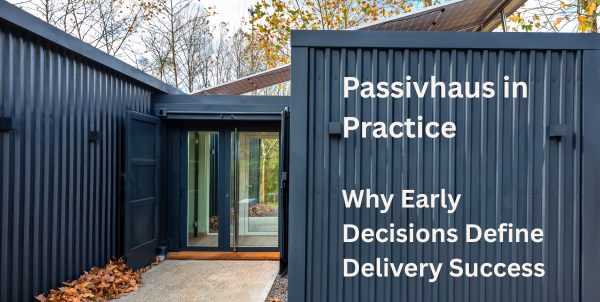
Passivhaus in Practice: Why Early Decisions Define Delivery Success
The delivery of two affordable Passivhaus schemes in Harpurhey, Parkmount Road and Princedom Street, offers a valuable lens into the realities of delivering high-performance housing…
Learn More
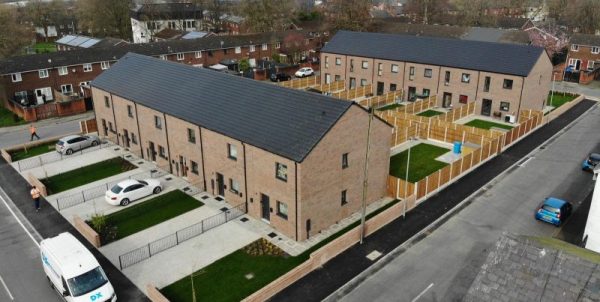
Beyond Compliance: Creating Buildings That Perform for Generations
Why sustainability, retrofit and long-term thinking are becoming central to delivering better projects. Throughout Poole Dick’s Question Time series, one message has remained consistent. The…
Learn More
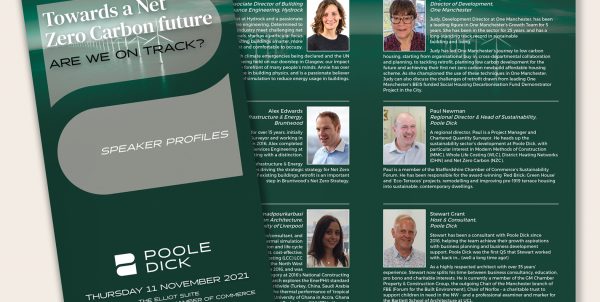
Fantastic to see so many people at our net zero carbon event in Manchester!
‘Towards a Net Zero Carbon future – are we on track?’, Thursday 11 November What a brilliant turnout for our net zero carbon event in…
Learn More