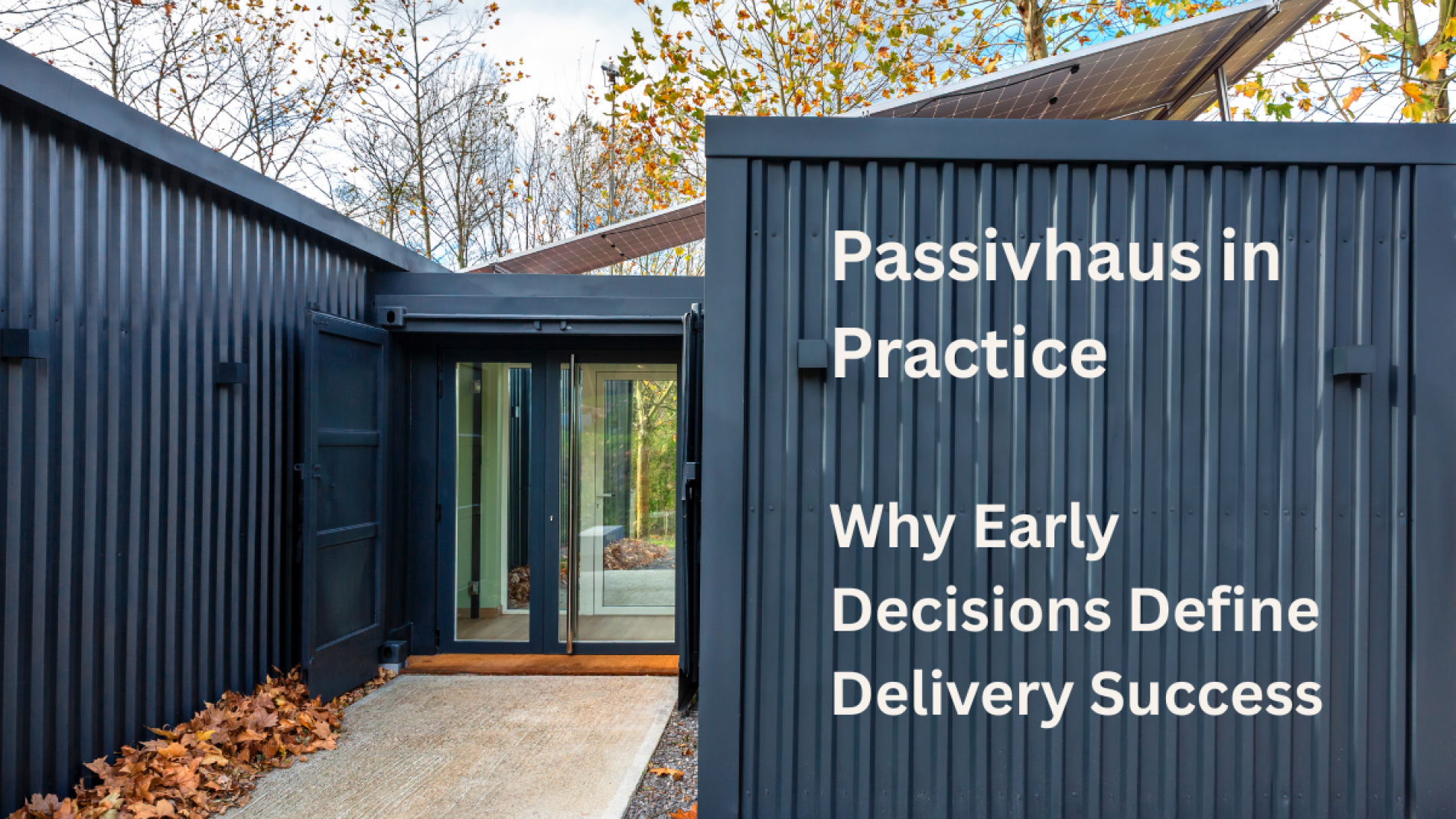
Passivhaus in Practice: Why Early Decisions Define Delivery Success
The delivery of two affordable Passivhaus schemes in Harpurhey, Parkmount Road and Princedom Street, offers a valuable lens into the realities of delivering high-performance housing at scale.
While both schemes achieved strong cost certainty, the journey to completion highlights a critical truth: Passivhaus is not simply a specification; it is a commitment that must be embedded from the outset.
Across both developments, Poole Dick acted as Employer’s Agent and Quantity Surveyor, working alongside John Southworth Builders and AEW Architects, with GWP Architects supporting on Princedom Street. The schemes delivered 46 affordable homes built to Passivhaus standards, an ambitious brief with clear long-term benefits for residents.
“Too often, Passivhaus is approached as an enhancement rather than a foundation. Our experience shows that unless it is embedded from the very beginning, projects will encounter avoidable challenges during delivery.”
Andrew Bayley, Director, Poole Dick
From a cost perspective, both projects performed exceptionally well. Final accounts aligned almost exactly with contract sums, demonstrating robust commercial management and disciplined cost control. However, programme performance told a different story. Parkmount Road extended from a planned 52 weeks to 103 weeks, while Princedom Street moved from 60 to 73 weeks.
“Cost certainty is achievable, even on complex schemes, but programme certainty is far more dependent on early coordination and decision-making. That is where the real difference is made.”
Martin Brownsill, Managing Director, Poole Dick
This divergence between cost and programme reinforces a key lesson: late-stage alignment creates early-stage risk. On both schemes, the contractor was appointed post-planning. While this is a familiar procurement route, it limited early contractor input into design development, particularly critical on a technically demanding standard such as Passivhaus. The result was a need to resolve buildability, sequencing, and detailing challenges during delivery rather than design.
“Early contractor involvement is not just beneficial on Passivhaus schemes, it is essential. It allows the whole team to align around buildability, cost, and performance before those pressures hit on site.”
Andrew Bayley, Director, Poole Dick
The takeaway is clear. Passivhaus decisions must be made at RIBA Stage 1, not retrofitted into developed designs. Early contractor engagement allows the design team to balance performance targets with practical construction methodologies, reducing rework, delays, and inefficiencies
later in the programme.
Luke Taylor reflects on the experience:
“Looking back, one of the biggest lessons was the value of bringing construction expertise into the conversation as early as possible. Many of the challenges encountered during delivery could have been identified and resolved much earlier through collaborative planning.”
This approach is becoming increasingly important in the context of the Future Homes Standard and the Greater Manchester Combined Authority Modern Methods of Construction design guidance, both of which reinforce the need for early-stage alignment between design intent, buildability, and delivery strategy.
Equally important is the selection of the right team. Designing to Passivhaus standards requires either proven experience or the integration of specialist consultants, particularly around the Passivhaus Planning Package PHPP.
Simplicity also emerged as a critical success factor. Passivhaus works best where designs avoid unnecessary complexity. Clean, consistent detailing improves buildability, supports quality control, and increases the likelihood of achieving certification the first time.
Luke Taylor adds:
“Passivhaus is incredibly rewarding to deliver, but it leaves very little room for compromise. Every detail matters, from the earliest design decisions through to the final quality checks on site. Everyone involved has to understand what they are trying to achieve.”
Beyond design and construction, the resident experience cannot be overlooked. Passivhaus buildings perform differently, and without proper understanding, the intended energy and cost benefits can be lost.
Initiatives such as bespoke home user guides, QR-coded plant instructions, and post-occupancy support are essential components of successful delivery. Finally, quality assurance is non-negotiable. Continuous on-site testing, supply chain alignment, and rigorous oversight are required throughout the build process.
“Achieving Passivhaus standards requires a collective commitment. From design through to occupation, every stakeholder has a role to play in delivering the intended outcome.”
Andrew Bayley, Director, Poole Dick
A Call to Industry
The direction of travel is clear. As regulatory expectations tighten and delivery pressures increase, the industry can no longer afford to treat Passivhaus, or equivalent performance standards, as an overlay to traditional design and procurement.
Those who continue to approach it this way will face increasing pressure on programme, cost, and delivery certainty.
Those who embed it early, align teams from the outset, and simplify where possible will be best placed to deliver not just compliant schemes, but high-performing, future-ready homes at scale.
As Martin Brownsill concludes:
“The question is no longer whether the industry can deliver to these standards. The real question is whether we are prepared to change how we work in order to deliver them consistently.”

Why 68% Wouldn’t Join Construction – and What We Can Do About It
The skills gap isn’t just a pipeline problem. It’s a perception problem. At Poole Dick’s recent Question Time event, the conversation kicked off with some…
Learn More

What’s in a Name!
Have you ever tried to name something? If you’re a parent I suppose the answer is “yes” and you quite possibly agonised over the choice.…
Learn More

Qatar 2022 World Cup Competition
As Southgate names his England squad we are launching our Qatar 2022 World Cup Competition in order to raise much needed funds for Crisis at…
Learn More