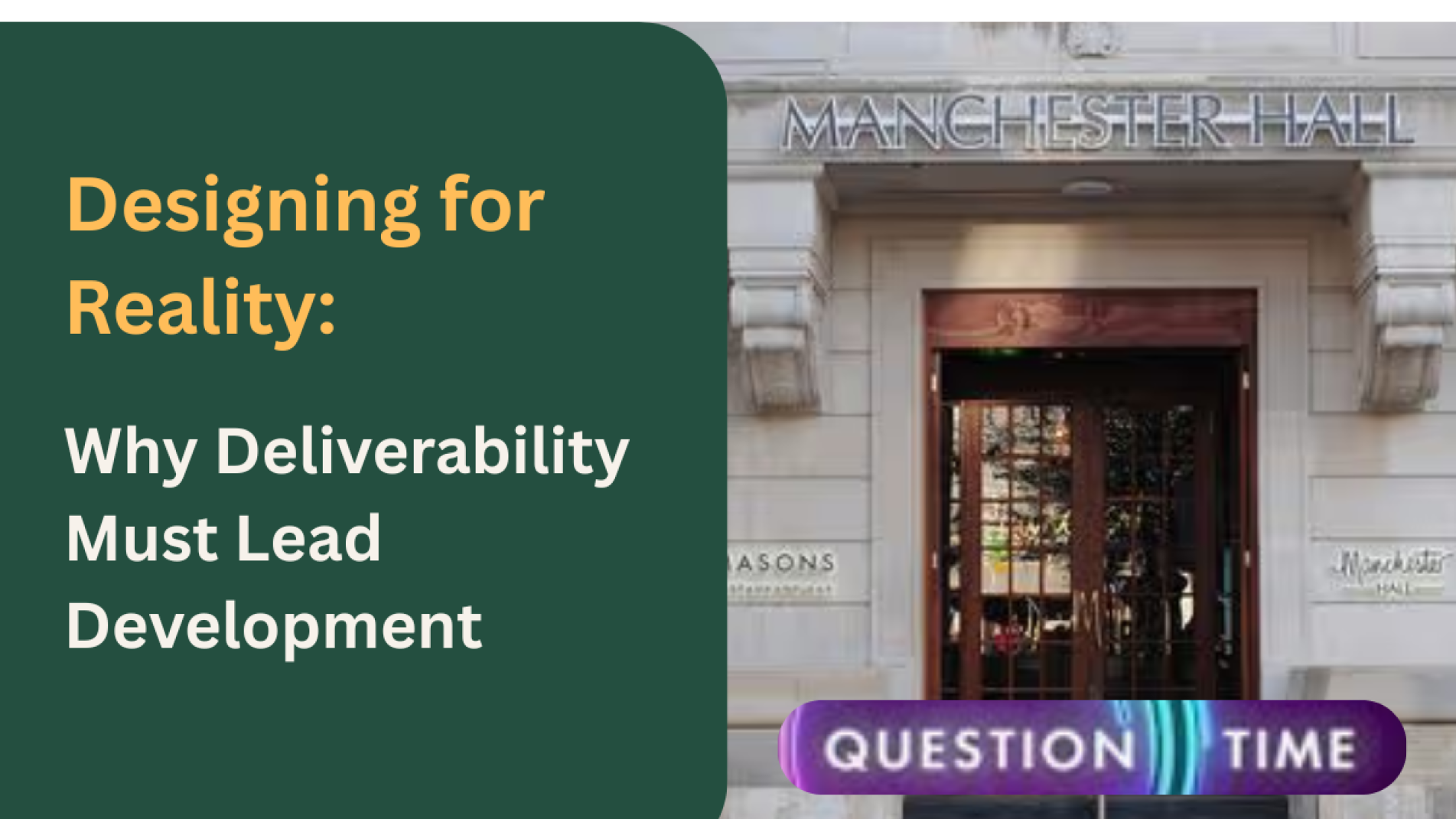
Designing for Reality: Why Deliverability Must Lead Development
If the earlier discussions around growth and planning highlighted the scale of opportunity across the North West, the next question is far more practical. Can it actually be delivered?
At Poole Dick’s recent Question Time event, this issue came into sharp focus. There was a clear sense of optimism in the room, but it was matched by a grounded understanding of the challenges that sit behind bringing projects forward. Confidence in the pipeline remains strong, yet delivery is becoming more complex, more pressured and, in many cases, more uncertain.
The challenge is not a lack of ambition. It is whether schemes can be delivered in real conditions.
Too often, projects are still conceived in stable scenarios where cost certainty, programme alignment and supply chain capacity are assumed. In reality, those conditions rarely exist. Instead, developers and delivery teams are navigating a combination of cost volatility, programme pressure, labour constraints and increasing regulatory expectations. Each of these factors introduces risk. Together, they create a level of complexity that cannot simply be absorbed later in the process.
“Too many schemes only work in perfect conditions.” — Angela Mansell
This observation reflects a wider issue across the industry. Viability is still too often treated as something to be tested once key decisions have already been made. By that stage, the ability to influence outcomes is limited. Projects become more exposed to redesign, delay or, in some cases, failure to progress at all.
This is why deliverability needs to be embedded from the outset.
“Good growth is deliverable growth.” — Panel consensus
This shift in thinking represents a fundamental change in how success is defined. It is no longer about the scale of opportunity or the strength of the pipeline. It is about what can realistically be built, completed and occupied. That requires a more grounded approach to development, where delivery is not an afterthought but a central part of decision-making.
A key part of this is earlier engagement. Contractors and supply chain partners bring practical insight into cost, programme, and buildability. When that expertise is introduced early, projects benefit from better alignment, more realistic assumptions, and stronger outcomes. When it is not, avoidable challenges emerge later, often at a much greater cost.
“We need to design for reality, not perfection.” — Angela Mansell
Designing for reality means acknowledging constraints rather than working around them. It means making informed decisions based on current conditions, not ideal ones. It also requires a shift in mindset across the project team, in which collaboration is prioritised, and delivery is considered at every stage.
There is also a broader structural issue at play. The stop-start nature of major projects continues to create instability across the supply chain. Without continuity, skills are lost, capacity fluctuates, and long-term planning becomes increasingly difficult. This has a direct impact on delivery, reducing efficiency and increasing risk across the board.
A more consistent pipeline of work would allow organisations to plan with greater confidence, retain skills, and invest in capability. It would also support more sustainable delivery across the region.
Ultimately, delivery is not the responsibility of a single party. It is shaped by decisions made across planning, design, construction, and operation. When those decisions are aligned, projects move forward with greater certainty. When they are not, progress slows and risk increases.
“If you change nothing, nothing changes.” — Angela Mansell
The message from the panel was clear. The industry does not need to reduce its ambition, but it does need to rethink how that ambition is delivered. That means designing with delivery in mind, engaging the right expertise earlier, and accepting the realities of current conditions.
Because in today’s environment, the difference between a project that progresses and one that stalls is not vision. It is deliverability.
To discuss any points raised here or in any of the Question Time insights, get in touch with the team through the links on the team page
“If you change nothing, nothing changes.” — Angela Mansell

Inform, Educate, Inspire – the ‘Poole Dick Academy’
“Do you find yourself sitting on the sofa in the evening, TV remote in hand, flicking through the channels trying to decide what to watch?”…
Learn More
Poole Dick Selected for Innovation Chain North Framework
Poole Dick has been chosen to provide consultancy services for the new Innovation Chain North (ICN) framework, managed by social landlord Great Places Housing Group.…
Learn More
Organisations celebrate as £1.5 billion Innovation Chain North framework announced
Great Places Housing Group has announced successful bidders for its latest four-year Innovation Chain North (ICN) framework of contractors and consultants. The framework has been…
Learn More